
Ten low-cost (or no-cost!) ways to save energy
 There is ALWAYS more an organisation can do to reduce energy consumption and costs – and many of these will cost little or nothing to implement! In fact, it is a myth that most organisations have found and picked their “low hanging fruit”. There are many reasons for this, but the key to unlocking more savings is to be open to exploring opportunities! Your advisors may not have the expertise in all areas to advise you in the best way or, if they are not equipment agnostic, may possibly have a vested interest in expensive projects.
Furthermore, there is never an end date to energy savings - the job is never done! Continual improvement is essential to off-set rising energy prices and maintain profitability.
This is going to be even more critical going forward if this country is going to meet the Government’s carbon targets. The scope for energy consumption savings, both technical and behavioural, is immense, maybe even 80%, and we are far from getting anywhere near to this! A comprehensive energy audit is always a great place to start, but here are some ideas and suggestions about what more you could be doing.
1. Is your Building Management System (BMS) wasting money?
It would be wrong to assume that building management systems manage energy efficiently; most are wasting vast amounts of energy!
Yes, that is a bold statement – but we have yet to find a BMS that couldn’t be optimised to save energy. Potential savings range from 10-50%.
That’s the bad news – the good news is that most of the solutions are very cheap and far more commercially attractive than most energy-saving projects.
Even organisations that employ full time BMS engineers, or have BMS maintenance contracts, frequently have seriously dysfunctional systems. This results in the massive wastage of energy, increased costs and uncomfortable environments for building users.
An underperforming BMS can be due to:
- inappropriate specification or control strategy
- incorrect installation or commissioning
- sensors faulty, poorly installed or positioned
- settings not updated to suit changing patterns of building use etc
- inadequate training
- inadequate maintenance
When we carried out a BMS healthcheck and system optimisation at Leeds university substantial energy savings were made.
“The BMS and M&T System Optimisation work has enabled my team to make substantial energy savings and to manage energy more effectively to drive down future costs and carbon emissions. In addition, we have been able to apply the learnings to extend the optimisation work to the remainder of our estate. In my opinion, the value of TGC’s (JRP's) contribution significantly outweighs their fees.” Energy Manager, BMS Optimisation University of Leeds.
Request a quotation for a BMS health check here.

2. Do things differently!
The potential for saving energy through changing behaviour is immense! It is estimated that at least 50% of the available energy saving potential lies in behaviour change.
Energy behaviour change means changing an organisation's culture to make improving energy efficiency, consumption, costs, emissions and management everyone's responsibility in every part of the organisation's operations.
We know that training can be an extremely effective way of engaging people to deliver real energy and cost savings within an organisation. Where savings are seen most keenly, however, is when the culture, structure and processes of an organisation also change to ensure that the engagement, awareness and commitment achieved through training is embedded and maintained.
Merthyr Tydfil County Borough Council saved a massive 15% gas and 13% electricity through a behaviour change programme. We delivered a behaviour change programme for Rolls-Royce which resulted in a reduction in energy consumption by 8.9% energy at a time when production was increasing! It is interesting that the saving from behavioural projects was the same as from the new factory LED lighting scheme at only 6% of the cost, with a payback of approximately 3 months.
In both cases, the results were measured using the principles of IPMVP, the internationally recognised verification methodology.
We can only access these savings by harnessing the power of people and embedding sustained best practice from within.
3. And do it now! Doing nothing has a cost.
Failure to implement energy saving opportunities can have a significant cost to an organisation. Inaction ignores the stresses to the business posed by rising energy prices, ignores increased costs associated with production growth, ignores the profit or investment potential of any savings realised and also ignores the social gains of reduced environmental impact. So how can this message be communicated effectively?
If you are struggling to make the case for implementing energy saving projects, it could be that person who holds the purse strings just doesn’t appreciate the true COST of inaction.
So how can this message be communicated effectively?
JRP have been able to successfully demonstrate a compelling case for action to key decision makers in a really impactful way with a Cost of Inaction Analysis. This is a comprehensive analysis of the cost of inaction versus the benefits of implementation. It factors in the implementation of potential energy saving measures and projects, the impact of varying production and rising energy prices. It also shows how the savings are magnified each year due to the continually increasing price of energy.
4. Use your data.
What is your data telling you? It’s amazing how many organisations collect data and then don’t do anything with it!
And many don’t even have a consistent, complete data collection regime – in fact obtaining all the necessary data was the biggest challenge we, and our clients, experience during the latest ESOS compliance process.
Your data tells you a story about what is going on in your organisation – how much energy is being used and where, but much more than that – it can tell you where efficiencies can be made! Working with the Ashville Group, we used their data to improve the accuracy of their carbon footprint and helped them understand their data, leading to making actual energy savings. Another JRP client that manufactures vinyl floor covering was able to save nearly £200k pa on their energy bills following recommendations from our detailed data analysis. Our Data Solutions Services helped them identify opportunities and track savings from energy conservation measures.
Have you checked your Out of Hours (OOH) energy consumption? We recently did checks for several organisations for their ESOS audits – potential for savings from better control of OOH consumption identified potential excess energy use of nearly £200k for one client! An site visit by one of our thermodynamic engineers costs less than you think and could potentially save ££££s. Book a call to discuss with one of our experts here.
If you don’t check your data – you could even be overpaying for energy without even realising it! We helped one NHS trust save ££££s simply through bill validation.
Whether it’s simply for efficient management of utilities or providing vital information for Net Zero/ESG reporting, it is essential to understand what the data is revealing about the organisation. We work with clients’ data to identify areas where efficiencies can be made, suggest targets and provide profiles of usage for sites, making it easier to identify costs and emissions savings and efficiencies to demonstrate positive environmental credentials.
From identifying the right utility supplier and contract for your business and bill validation, right through to supporting the implementation of any improvement opportunities identified, making your data work for you. These are all areas where there are potential savings to be made: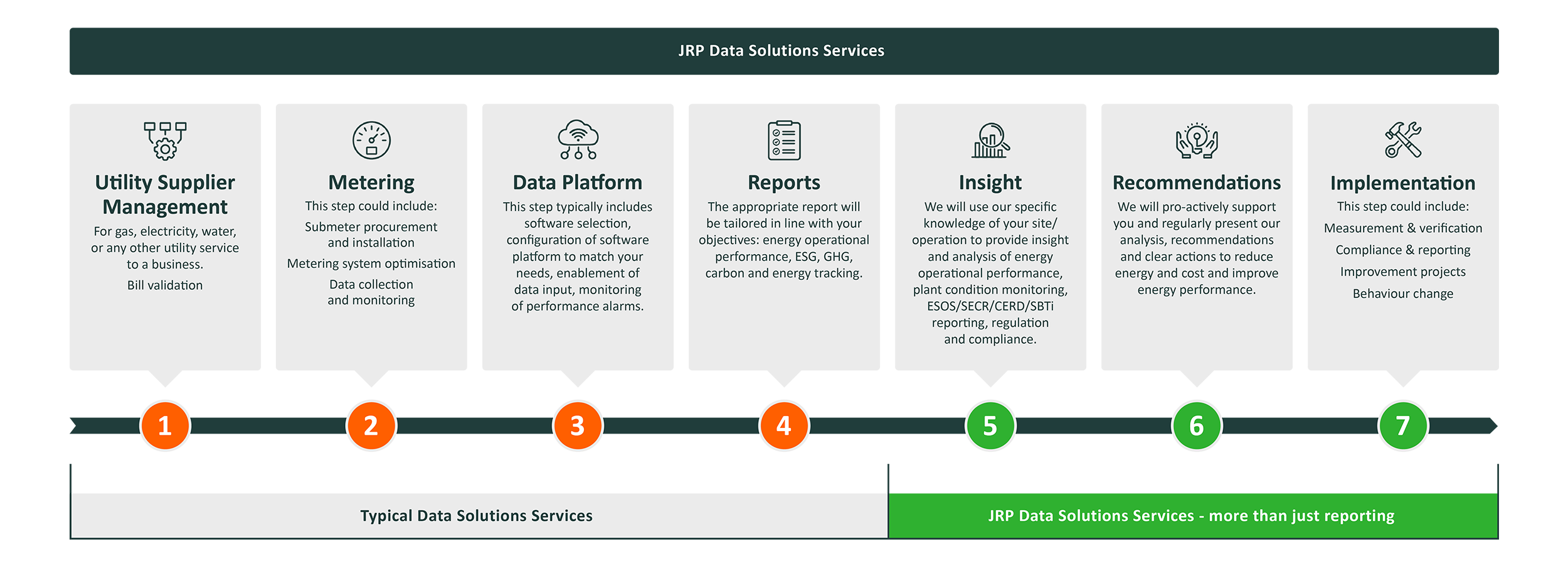
- Utility/Supplier Management
- Metering
- Data Platform - Monitoring and Targeting
- Reports and Insights
- Recommendations
- Measurement and Verification
- Management Software
- Regulation Compliance
- Carbon Reporting
5. Are you getting best value from your FM or ESCO provider?
Companies that successfully implement tailored and well managed outsourcing programmes can realise real tangible and long-lasting business benefits and enjoy partnering relationships with trusted suppliers who focus on the client’s organisational goals and objectives. However contracts or agreements such as Utilities Management Agreements, Energy Performance Contracts or Power Purchase Agreements are not always set up with the best interest of the organisation in mind and without ongoing performance reviews.
An audit of services, a ‘Provider Audit’, can be a very effective way to interrogate the appropriateness or otherwise of a facilities management or ESCO provider and can identify improvements in the efficiency and effectiveness of any arrangements.
This approach:
- Reduces negotiation time for new contracts
- Ensures the selection of the most suitable provider.
- Optimises self-delivery by identifying areas for improvement
- Provides sense/health check of existing providers as a basis for reviewing KPIs and contract terms.
- Enables decisions based on organisational priorities
- Provides comprehensive information on which to base informed decisions
This was the approach taken by Toyota, the originator of Toyota Production System and lean manufacturing techniques, when they were seeking break-through activities to improve in house efficiency and cost in the area of maintenance activities at their plants. They appointed JRP Solutions to undertake a review of the maintenance operations at their manufacturing facility at Burnaston.
“JRP provided a clear direction to us and throughout the process have been a guiding hand, listening to our concerns and providing patient answers to our many questions. The process by which we made our selection was logical and based on a sound understanding of our objectives.” Senior Manager, Purchasing & Cost Management.
6. Is ISO 50001 certification your route to better energy efficiency?
Implementing the energy management standard ISO 50001 makes good business sense as part of a structured and coordinated approach to reducing energy use. Yes, there will be a cost to developing an approach to certification and actually achieving it, BUT, and here is the great thing about this standard, as soon as you start working towards it, you start to work practically to maximise energy and cost savings!
It’s not all about achieving certification – the journey itself and the discipline of the framework gives you the tools, processes and procedures to make savings.
Whether or not you are already certified to ISO 50001, it is worth regularly reviewing whether it could be working, or working harder, for you! We’re in regular contact with organisations that have achieved certification to ISO 50001 and we know that certification is not the end of the journey, we also know that there is always more that can be done to improve energy efficiency and management. The scope for energy consumption savings, both technical and behavioural, is immense.
7. How do Vodafone and Severn Trent Water manage 1000s of energy projects?
 The way energy projects are managed can have a significant impact on the output. A holistic approach to energy project management is essential to enable an efficient, effective, prioritised approach that maximises savings. This is how Vodafone and Severn Trent Water do it. Read more.
Achieving energy management and sustainability goals while tracking progress can be incredibly challenging. Identifying which projects to prioritise, managing multiple initiatives, and evidencing success often become overwhelming tasks.
To address these challenges, JRP Solutions, in collaboration with customers and industry experts, have developed Project Activator® — a dynamic, user-friendly, low cost, web-based project management and reporting tool.
Project Activator® empowers businesses to make better decisions with real-time, actionable data. It tracks, manages, and reports the progress and impact of energy, carbon, and cost-saving projects, converting measurements not just into kWh or currency but also into CO2e across Scopes 1, 2, and 3. Gone are the days of relying on cumbersome spreadsheets for your calculations. It provides
- Time and Cost Savings: Streamline project management, reducing the need for manual updates and saving valuable resources.
- Comprehensive Idea Capture: Record all suggestions, opportunities, and projects in one place.
- Real-Time Project Status: Always know the current status of your projects with an up-to-date, live listing.
- Consistent Processes and Reporting: Ensure uniformity in process and reporting, enhancing reliability and comparability.
- Global Access and Data Transparency: Access the platform from anywhere in the world.
- Informed Decision-Making: Support strategic and tactical decisions with detailed operational, commercial, and environmental insights.
- Prioritisation and Investment: Easily prioritise and select the most impactful projects.
- Centralised Data: Keep all relevant links to documents, images, and schematics in one accessible location.
- Automated Reporting: Generate custom reports that aid in capital planning, budget forecasting, and environmental reporting.
- ISO 50001 Support: Align with the requirements for ISO 50001 accreditation.
To find out more about Project Activator®, book a call with one of our team here.
8. Do you have a beast in your basement?
Or somewhere else on your site somewhere? Boilers, CHP, district heating, biomass, PV, wind turbines, generators, renewables, steam, ovens, effluent plant – all these expensive bits of kit need to be specified, maintained and managed effectively to ensure their on-going suitability and efficiency. Let’s just look a boilers as one example where it is possible to get it wrong.
Most boilers waste a significant proportion of their input energy for much, if not all, of their operating lives - a fact that is largely unrecognised and unaddressed by those who specify, install and manage them. Tackling boiler inefficiencies is a top priority if you want to reduce energy consumption and cut costs with an excellent return on investment.
What are the issues?
The vast majority of buildings have boiler plant that is significantly over-sized for the load that it is required to satisfy. There are all sorts of reason for this but significantly, boiler plant is usually designed to include substantial additional capacity for such things as excessive safety margins, plant breakdowns and possible future building extensions. Thus, the majority of plant is actually over-sized throughout its operating life, usually by a very significant margin.
Over-sizing is just one issue – others include: standing losses (radiation): purging (a pre and post-fire process that can be very inefficient if not co-ordinated effectively with the active boiler time); sequencing and isolation (when the boiler power is effectively providing more output than is required at any given time); combustion efficiency (typically only checked after boiler maintenance and scant attention paid to figures which are not always accurate. Ideally, combustion efficiency should be checked between maintenance periods. A few per cent loss of efficiency can represent a substantial annual cost and may also be a symptom of health and safety issues.)
What you can do
Speak to us about getting a Plant and Equipment healthcheck! One of our engineers could help you to reduce energy consumption and costs and deliver more comfortable conditions for building users by:
- Accurately determining the maximum load, removing and selling any surplus boilers
- Controlling the remainder appropriately
- Hydraulically isolating those not in use at any one time
- Ensuring correct maintenance and boiler efficiency
With a bit of effort and the right expertise the rewards are high.
Book a no-obligation consultation to discuss your situation here.
9. Take compliance and regulation seriously!
We are a bit passionate (can you be just a ‘bit’ passionate?) about sustainability, which is why we share so much of our expertise to guide businesses to better practices. We have turned down business from organisations we know are just doing a tick box exercise for legal compliance or for virtue signalling ☹.
What is the point of spending money to get an ESOS audit and action plan done and then not intending to do something with it? Why spend money on creating a 50-page impact report full of green-washing (this happens! We were asked to tender for one – we declined!). Energy is an expensive resource, the use of which has environmental consequences. It is the role of governments worldwide to control, manage and reduce energy use and the resultant Greenhouse Gas emissions but it is the responsibility of individual organisations, to do their bit too! There are many, often complex and overlapping schemes, some voluntary, some compulsory, which have been set up to do this and they all need to be undertaken with commitment and serious intent. Not to tick a box, not to just be compliant, not to show ‘green credentials’ but to make a difference! You can download our free ESG Jargon Buster – a guide to all the different regulations and standards here.
To state the obvious – if you save energy – you will save money!
(To save even more money, why not take advantage of our 'Wrapped Up' agreement which will deliver SECR, energy data management, ESOS Action Plans and ESOS Phase 4 compliance under one cost-effective framework. PLUS, we will give you the added benefit of our energy and compliance expertise to ensure you derive the absolute maximum from meeting your regulatory requirements.)
You can book a one-to-one consultation here to discuss any aspect of compliance and regulation.
10. How can you increase your resources without increasing overhead?
It’s the age-old conundrum – not enough time and money to save time and money …. and potentially win the battle!
People: There are times in all organisations when there just isn’t the right expertise, or enough hours in a week, to deliver an organisation’s expectations effectively. The required resource may not be available to manage a project, or a particular task, for example, and an in-house and a full-time person cannot be economically justified. Have you considered the option of a draw-down support agreement? This can be a really cost effective and flexible route to driving a successful energy/carbon management and cost reduction programme. The service can be provided on a call off basis with time drawn down as required for specific tasks or regular attendance where time is only paid for as and when work is carried out. Deployment is by agreement, typically on a month-by-month basis, based on a pre-agreed number of days and level of cost, which can be directed by you to assist with, or trouble shoot, any related issue. This will ensure the changing needs of your business are always met at a known cost.
This approach to resourcing this energy/carbon management can address an organisation's requirements for:
- Temporary specialist expertise
- Part time energy management
- Fluctuating energy support
- Specialist expertise not available in-house
- Adapting to changing business needs and priorities
With complete flexibility as to how and when this service is called upon and how it’s deployed, costs are minimised, resources optimised and targets are achieved.
Book a no-obligation call to discuss your situation here.
Money: Is lack of funding stopping you accelerate your energy/carbon management plans? Whether it’s better data management, a behaviour change project, a range of solar panels, a building management system, more efficient plant, a wind farm or a fleet of electric vehicles, there are all sorts of ways to finance these without taking a chunk out of your working capital or adding to your overheads. E.g.
- Specialist financing: Where funding is a barrier to implementation of larger capital projects, we can help businesses finance their emissions-reducing projects through specialist funders.
- Shared savings: This is where projects can be progressed with no upfront costs, based on savings achieved being shared between the service provider and the client.
- Look at the Return on Investment! Many of the energy saving suggestions above have very little outlay with an ROI of under 12 months! If you make sure that savings can be verified using IPMVP, Finance Directors will be supportive – they love these sort of stats!
You can book a no-obligation consultation to speak about any of the above with one of our experts here.
Or you can call us on 0870 394601or email george.richards@jrpsolutions.com