What is carbon offsetting and why is it still important for Net Zero?
Reducing greenhouse gas (GHG) emissions should always be the priority for organisations on the journey to Net Zero. But even after implementing reduction measures, most businesses will still have unavoidable emissions that cannot yet be eliminated.
This is where carbon offsetting has an important role to play.
Carbon offsetting enables organisations to balance these residual emissions by supporting independently verified projects that reduce or remove greenhouse gases elsewhere. When used as part of a wider carbon reduction strategy, not as a substitute for reducing emissions, it can help organisations take responsibility for emissions that cannot currently be avoided.
What are carbon offsets?
A carbon offset represents a verified reduction or removal of greenhouse gases that is used to balance an equivalent amount of emissions produced by your organisation.
While the principle sounds straightforward, high-quality offsetting is far more than simply purchasing carbon credits. Effective offsetting relies on robust carbon accounting, independent verification and selecting projects that deliver genuine, measurable climate benefits.
When should organisations consider offsetting?
Offsetting should form part of a structured Net Zero strategy, not the starting point.
The first step is understanding your organisation's carbon footprint across Scope 1, 2 and 3 emissions, identifying where emissions can be reduced, and developing a clear reduction roadmap. Only then can you determine which emissions remain unavoidable and where offsetting may be appropriate.
Not all carbon offsets are created equal
The quality of an offset project matters just as much as the quantity of carbon it claims to save.
There are many different types of carbon projects, each with varying environmental, social and economic benefits. Understanding how projects are verified, what makes an offset credible and how to avoid low-quality schemes is essential if your investment is going to make a meaningful difference.
Is offsetting the only option?
Not necessarily.
As organisations mature their sustainability strategies, many begin to explore complementary approaches such as investing directly in emissions reductions within their own operations or value chain. Understanding where offsetting fits alongside these approaches is an important part of building a credible, long-term decarbonisation strategy.
Download the carbon offsetting factsheet
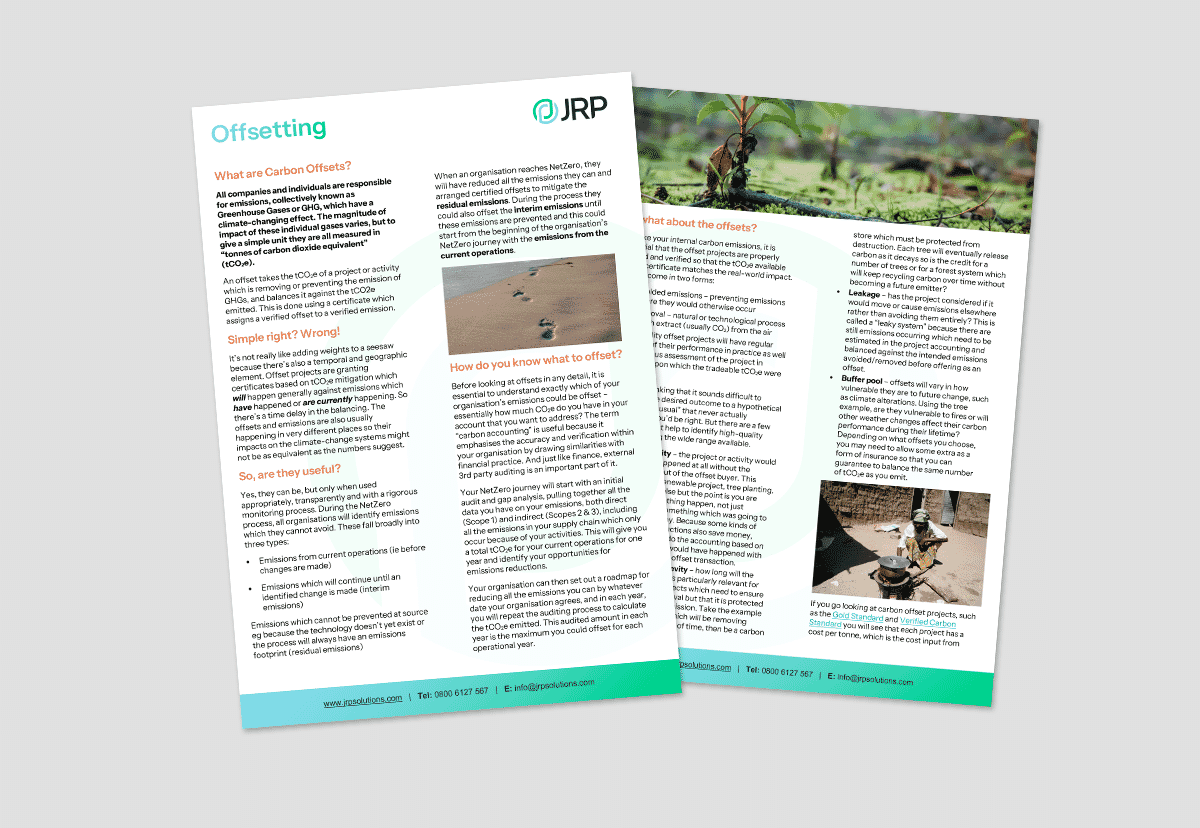
If you're considering carbon offsetting as part of your Net Zero journey, our free factsheet explains:
- What carbon offsets are and when they should be used
- How to identify which emissions are appropriate to offset
- What makes a high-quality, credible offset project
- The difference between avoided emissions and carbon removal
- Alternatives to offsetting and how they fit into your wider carbon strategy
- The practical steps involved in developing an effective offsetting approach
Download the Carbon Offsetting Factsheet below to learn how to use carbon offsetting responsibly as part of a robust Net Zero strategy.
DOWNLOAD THE FREE FACTSHEET
Enter your details to get access to this free factsheet
We are offering free downloads of our factsheet to energy and sustainability professionals involved in any part of their organisation’s sustainability or Net Zero journey. If you would like a link to the factsheet, please request it here.
"*" indicates required fields